How to · 18 September 2026 · 4 min read
How to Find Your Dog's Separation Anxiety Baseline With a Camera
A baseline is how long your dog can be alone before distress starts. Here is how to measure it properly with a camera, what to subtract, and why one measurement is never enough.
By Elio
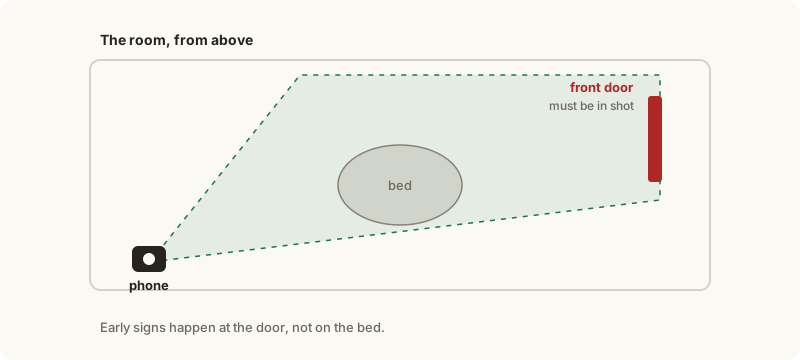
The first real question in separation anxiety training is a number: how long can your dog currently be alone before they start to struggle. Everything after that — session lengths, progressions, drop-backs — is built on it.
It is also the step people most often get wrong, usually by measuring once, on a good day, and training against a number their dog cannot actually hit. Below is the version that holds up.
What do you need before you measure a baseline?
A camera with the door in frame, and somewhere to watch it from that is genuinely out of sight and earshot.
The camera matters less than the framing. A phone propped against a wall is fine. What is not fine is a view that only covers your dog's bed, because door-watching and door-return behaviour are where the earliest signals show up, and a bed-only view will have you scoring a dog who looks settled while they are actually stationed at the door between checks.
Skip the treat, the stuffed Kong and the long walk beforehand. All three change the measurement, and you want the number for an ordinary departure, not an optimised one.
How Duckie helps: Duckie works with the camera you already have, and reads posture and door proximity rather than only motion, so a dog frozen by the door does not register as calm.
Where should you watch the camera from?
Somewhere your dog cannot hear you, smell you, or hear your car. A stairwell, a neighbour's flat, a car parked a street away.
This sounds fussy and is not. Dogs routinely settle differently when an owner is sitting in the hallway, and a baseline measured from four feet behind the front door is a measurement of a dog who knows you are there. If your building makes that impossible, drive somewhere and watch from the car.
Watch the whole time. The point of the exercise is to catch the first sign, and the first sign is easy to miss if you are checking the feed every few minutes.
How Duckie helps: Duckie watches the feed continuously and pushes an alert when it sees a sign, which removes the requirement to stare at a phone for the whole absence.
When exactly do you stop the clock?
At the first sign of distress that does not resolve on its own.
Not the first movement — most dogs move. Not the first bark — plenty of dogs bark once and then sleep. The moment you are looking for is the one where behaviour starts to build on itself: a dog who gets up and does not settle again, pacing that lengthens, vocalising that gets more frequent rather than less.
If you are unsure whether what you just saw counts, the escalation test is the one to apply. Then go in, calmly, and end it. Once you have seen the sign you have your number, and continuing past it buys you nothing but a distressed dog.
How Duckie helps: Duckie separates a spike that resolves from one that keeps climbing, which is the distinction the clock actually turns on.
How do you turn the number into a starting duration?
Take the time you recorded and trim a small margin off it — roughly five percent is the convention.
The margin exists because your baseline is the point where you saw a sign, and the real onset was slightly earlier. Training just under it means the first sessions are ones your dog passes, which is the entire point. Sessions your dog passes build tolerance. Sessions your dog fails build the opposite.
If the number comes out very small — two minutes, or thirty seconds — that is a normal result, not a failed measurement. Plenty of programmes start below a minute.
How Duckie helps: the recorded time to first sign carries forward into the next session's plan, so the starting duration comes from what the camera saw rather than from memory.
How many times should you measure it?
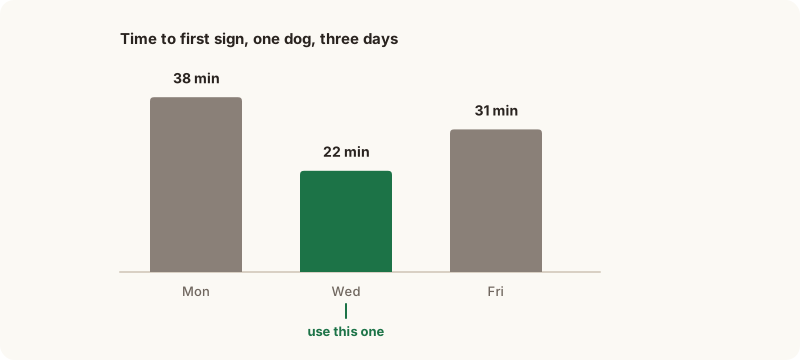
Two or three times, on different days and at different times of day, and then take the shortest.
A single measurement is a snapshot of one afternoon. The same dog can manage forty-five minutes cleanly on Tuesday and twenty-five on Wednesday, and midday and early evening can differ by more than an hour. If you train against the best of those numbers you will be over threshold regularly without understanding why.
Taking the shortest feels overly cautious for about a week, and then stops feeling that way when your dog is passing sessions consistently.
Final thoughts
A baseline is not an achievement to beat. It is the largest duration you can be confident about, which usually means a smaller number than the one you would like to write down. The owners who progress fastest are almost always the ones who started lower than they wanted to.
Duckie records time to first sign on every absence, so the baseline stops being a thing you measure once and becomes something you can actually watch move.
Working out your starting duration
Take the time on the clock when you saw the first sign that did not settle, and trim roughly five percent off it. That trimmed number is where training starts.
- First sign at 40 minutes gives a starting duration of 38 minutes.
- First sign at 12 minutes gives a starting duration of 11 minutes 24 seconds.
- First sign at 3 minutes gives a starting duration of 2 minutes 51 seconds.
- First sign at 45 seconds gives a starting duration of 43 seconds.
If you measured more than once, run the calculation on your shortest measurement rather than your best one.
Common questions
- How long should my dog's baseline be?
- There is no target. Baselines range from under a minute to several hours depending on the dog. A thirty-second baseline is a normal starting point for a dog with significant separation anxiety and says nothing about how far they will get.
- Can I measure a baseline with a regular pet camera?
- Yes, provided the door is in frame. Bed-only views miss door-watching and door-return behaviour, which is usually where the first signs appear. Audio-only devices miss silent pacing entirely.
- Should I leave my dog a Kong or a chew for the baseline?
- No. Food changes the measurement — it occupies the dog through the early minutes and many anxious dogs stop eating once distress starts, so the chew masks the onset rather than delaying it. Measure an ordinary departure.
- Do I need to redo the baseline later?
- Not as a separate exercise. Once training is running, each session's time to first sign is effectively a fresh measurement, and the trend across sessions is more useful than any single re-test.
- What if my dog shows no signs at all during the absence?
- Extend the next measurement rather than assuming there is no limit. If several longer absences also stay clean, your dog may not have separation anxiety, and the behaviour that prompted the concern may have another cause worth discussing with a vet.