Training · 18 September 2026 · 4 min read
What "Over Threshold" Actually Means in Separation Anxiety Training
Over threshold is the line between a dog who is coping alone and one who is not. How to read it on camera, why escalation matters more than any single behaviour, and what to do the moment you see it.
By Elio
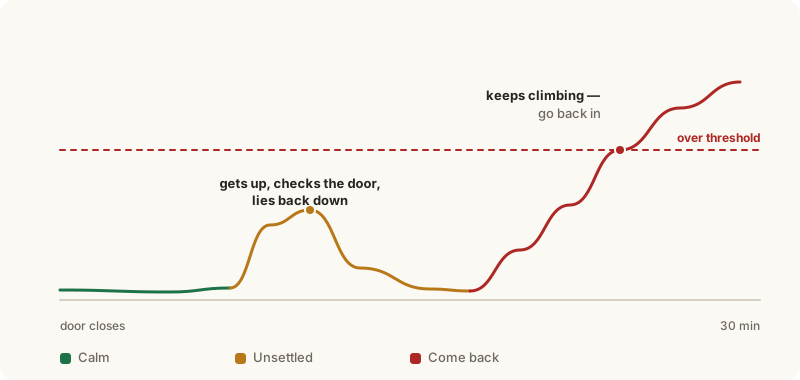
Two weeks into training, most owners can describe their dog's worst moment in forensic detail: the howl, the scratching, the puddle by the door. Almost nobody can describe the moment before it. That earlier moment is the one training actually runs on.
Get the line wrong in either direction and you stall. Read it too late and every session teaches your dog that being alone ends badly. Read it too early and you never build any duration at all. Duckie exists because that line is genuinely hard to hold in your head while you are standing in a stairwell watching a phone.
How do I know when my dog goes over threshold?
Look for a change in direction, not a change in behaviour. Standing up is not distress. Standing up, then pacing, then vocalising, each one closer to the last, is distress.
The useful mental model is a trajectory. Your dog's arousal goes up when you leave — that is normal and expected. What matters is whether it comes back down. A dog who rises, checks the door, circles once and lies back down has processed the departure and coped with it. A dog whose movements get faster and wider every minute has not.
How Duckie helps: the session timeline shows arousal as a shape over time rather than a list of events, so a spike that settles looks visibly different from one that climbs.
Is whining over threshold, or just settling?
A single whine on its own tells you very little. Plenty of dogs vocalise once as the door closes and then sleep for an hour.
The distinction owners in the separation anxiety community have converged on is escalation. One owner put the rule as well as any trainer: if the distress is at three out of ten and does not escalate to eight, it does not count as over threshold. That is a workable test. Whining that stays flat and then fades is your dog settling. Whining that gets louder, more frequent, or picks up pacing alongside it is your dog going under.
How Duckie helps: vocalisation is tracked alongside movement and posture rather than on its own, because a bark during pacing means something different from a bark from a lying-down dog.
Why do trainers say uncertain counts as over threshold?
Because the cost is asymmetric. Ending an absence thirty seconds early costs you thirty seconds. Ending it two minutes late can cost you weeks.
A dog who panics during a session does not just have a bad session. Panic during absences is what the training is treating, so a single over-threshold rep actively works against every rep that came before it. Recovery from one bad absence is routinely measured in weeks of dropped-back durations, which is a brutal exchange rate for the two minutes you were trying to win.
This is why "uncertain counts as a sign" is a rule rather than a suggestion, and why it holds even when you are fairly confident your dog was fine.
How Duckie helps: when the read is ambiguous, Duckie says so and recommends coming back, rather than resolving the ambiguity in favour of a longer session.
Does the threshold change from day to day?
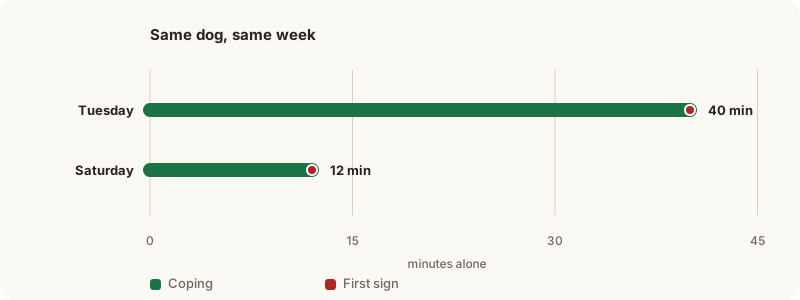
Yes, and more than most owners expect. Reports of forty-five clean minutes one day and twenty-five the next are ordinary, not a sign that something has gone wrong. Time of day moves it too — ninety minutes at midday and ten minutes in the early evening is a pattern several owners describe for the same dog in the same week.
That variability is the single best argument against training from a fixed number. If you decide on Monday that your dog can do thirty minutes and run thirty minutes every day that week, you will be under threshold some days and well over it on others, without knowing which.
How Duckie helps: every session records time to first sign, so the pattern across days and times becomes visible instead of something you try to remember.
What should I do the moment my dog goes over threshold?
Go back in, calmly, and end the session there. No treat, no greeting ritual, no apology. Walk in the way you would walk into any room.
Then shorten the next absence to a length your dog has already passed comfortably, rather than retrying the one that failed. The next session's job is to be easy. Owners who chase the failed duration tend to collect more failures; owners who drop back and rebuild get through the plateau faster.
Write down what you saw and when. If you have not measured a starting point yet, that is the baseline exercise. The time to first sign is the number worth tracking — far more than the longest absence you have ever achieved, which tells you about one lucky day and nothing about your dog's trend.
Final thoughts
Over threshold is not a behaviour you learn to recognise once. It is a direction of travel you learn to read, on a line that moves day to day. If your sessions have stopped moving despite getting this right, that is usually a plateau rather than a threshold problem. The owners who make progress are not the ones with the sharpest eye for lip licks — they are the ones who consistently come back a little early and let the easy reps stack up.
If you would rather watch your dog than referee them, Duckie watches the absence and tells you when to come back.
Common questions
- Is my dog over threshold if he only barks once?
- Probably not. A single bark or whine that fades is usually a dog processing the departure. What counts as over threshold is escalation — distress that climbs rather than settles. Watch what happens in the two minutes after the bark, not the bark itself.
- Should I use the first sign of movement as my baseline?
- No. Most dogs move during a normal absence. Use the first sign that does not resolve — the movement that leads to more movement rather than back to rest. That point, minus a small margin, is a workable starting duration.
- My dog went over threshold once. Have I undone my training?
- One bad absence typically costs you a drop-back, not the whole programme. Shorten the next few sessions to durations your dog passes easily and rebuild from there. Owners commonly report needing one to two weeks to return to the previous duration.
- Can I tell my dog is over threshold from audio alone?
- Only partly. Audio catches vocalising and scratching but misses the silent pacing and door-watching that often comes first. A dog can be well over threshold and almost silent, which is why bark-only alerts tend to fire late.
- How long does it take to find my dog's threshold?
- Usually a few sessions. Leave with a camera running, watch from outside, and come back at the first sign that does not settle. Repeat across different days and times, because the number moves — a single measurement is a snapshot, not a baseline.