Understanding · 18 September 2026 · 4 min read
Separation Anxiety or FOMO? How to Tell What Your Dog Is Doing
A dog who barks when you leave might be panicking or might just be annoyed. The difference shows up in the ten minutes after the door closes, and it changes what you should do next.
By Elio
Somebody mentions that your dog barks when you go out, and you are suddenly trying to work out which of two very different problems you have. One is a training problem with a straightforward fix. The other is a panic disorder that takes months of careful work.
The frustrating part is that the first ninety seconds look the same in both cases. Barking at a closing door tells you almost nothing on its own — which is exactly why a clip from a doorbell camera or a bark alert from a pet camera so often points people the wrong way.
What is the difference between separation anxiety and FOMO in dogs?
FOMO is frustration at being left out of something. Separation anxiety is panic at being alone.
A frustrated dog wants in on the walk, the car, the room you just closed. Their protest is aimed at the thing they are missing, and it fades once it becomes clear the thing is not happening. An anxious dog is not protesting an exclusion. They are reacting to being by themselves, and the feeling does not fade on its own because nothing about the situation resolves it.
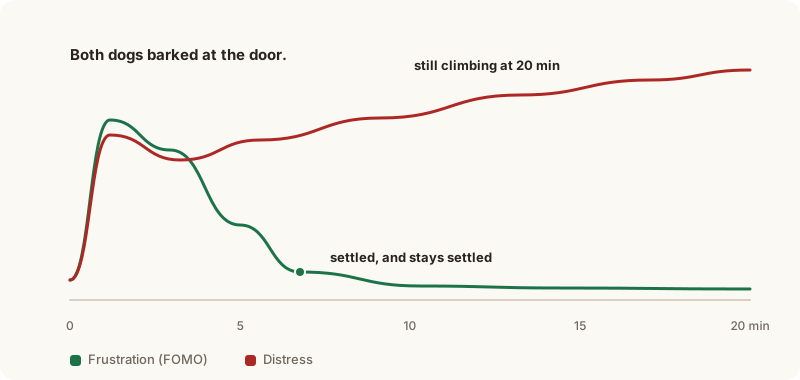
That difference in cause produces a difference in shape, and the shape is what you can actually observe.
How Duckie helps: Duckie reads the whole absence as a curve rather than flagging individual events, so the shape is what you end up looking at.
Does barking when you leave mean separation anxiety?
No. Barking at departure is one of the least diagnostic signals there is.
Dogs bark at departures for a long list of reasons: frustration, habit, the sound of the lift, a neighbour on the stairs, or simple protest. A dog with no anxiety whatsoever can bark hard for two minutes and then sleep for five hours. Meanwhile some of the most anxious dogs are near-silent, pacing and panting without making enough noise to trigger anything.
This is the specific failure mode of bark alerts. They fire reliably on the loud, undistressed dog and stay quiet for the silent, distressed one.
How Duckie helps: vocalising is one signal among movement, posture and door behaviour, so a quiet dog who is pacing is not scored as calm.
How quickly does a FOMO dog settle?
Usually within ten minutes, and the drop is obvious when you see it.
The pattern is a burst of activity at the door, a wander, sometimes a second shorter burst, and then a dog who lies down and stays down. The tell is that the second burst is smaller than the first. Frustration decays, because nothing is renewing it.
Anxiety does not decay on that timetable. A dog still pacing at twenty minutes, still panting at thirty, or cycling back to the door repeatedly through an hour is not working through frustration.
How Duckie helps: time to settle after the door closes is recorded on every absence, which turns "did he calm down?" into a number you can compare across days.
Can a dog have both separation anxiety and FOMO?
Yes, and it is common enough that treating them as mutually exclusive causes problems.
A dog can be genuinely frustrated in the first minutes — that is the FOMO part — and then slide into real distress once the frustration burns out and the aloneness is all that is left. What you see is an early burst that looks like protest, a brief lull that looks like settling, and then a second escalation that is a different thing entirely.
If you only watch the first ten minutes, you will read that dog as FOMO and train the wrong problem.
How Duckie helps: because the whole absence is recorded, a late second escalation shows up rather than being missed by an early check-in.
How do you tell the difference without guessing?
Film a full absence and watch the shape, not the highlights.
Leave with a camera covering both your dog's resting spot and the door. Watch from out of earshot. The full method is in how to measure a baseline. Give it at least thirty minutes if your dog can tolerate that, and look at the curve: does arousal come down and stay down, or does it stay up and climb?
One honest caveat. This tells you what your dog's absences look like, which is the useful, observable thing. It is not a diagnosis. Separation anxiety is assessed by a vet or a qualified behaviourist, and if what you film looks like genuine distress, footage of a real absence is the single most useful thing you can bring to that appointment.
Final thoughts
The question is not really "anxiety or FOMO". It is "does my dog come down, or not?" Everything else — which behaviours, how loud, how dramatic — is far less informative than that one curve.
Duckie watches the absence and records how long it took your dog to settle, so the answer comes from what happened rather than from the two minutes you happened to catch.
Which of these matched your dog?
Two of these point towards frustration, four towards distress. Count how many of each you saw across a full absence.
- Settled and stayed down within ten minutes — frustration
- The second burst of activity was smaller than the first — frustration
- Still pacing at twenty minutes — distress
- Panting continued past thirty minutes — distress
- Returned to the door repeatedly through the absence — distress
- Never fully lay down — distress
Two or more distress signals and no settling is the pattern worth filming and taking to a vet or a qualified behaviourist. This is an observation aid, not a diagnosis.
Common questions
- My dog only barks for five minutes. Is that separation anxiety?
- Probably not, if the barking genuinely stops and your dog then rests. A protest that decays within about ten minutes and does not return is much more consistent with frustration than with separation anxiety. Check the rest of the absence before concluding.
- Can a quiet dog still have separation anxiety?
- Yes, and silent cases are easy to miss. Pacing, panting, door-watching and inability to lie down are all distress signals that make no noise. Audio-only monitoring systematically under-detects these dogs.
- Is destructive chewing a sign of separation anxiety?
- It can be, but location matters more than the damage. Chewing concentrated at exit points — doors, frames, windows — is more consistent with panic. Damage spread around the house is more often boredom or ordinary adolescent chewing.
- Does my dog need a diagnosis before I start training?
- Gradual absence training is safe and useful either way, so you do not need to wait. Do involve a vet or qualified behaviourist if you see severe panic, self-injury or house-soiling in an otherwise house-trained dog, since those warrant professional assessment.
- How long should I film to tell the difference?
- Thirty minutes is usually enough to see the curve, provided your dog can tolerate it. If your dog goes into clear distress sooner, end the absence there — you already have your answer and there is nothing to gain from letting it continue.